Australia's National AI Plan: What the New Office of AI Actually Means for Your Small Business
The new Office of AI creates no obligations for SMEs yet, with legislation expected in early 2027. Here is what actually changes for Australian small businesses, and what to do now.
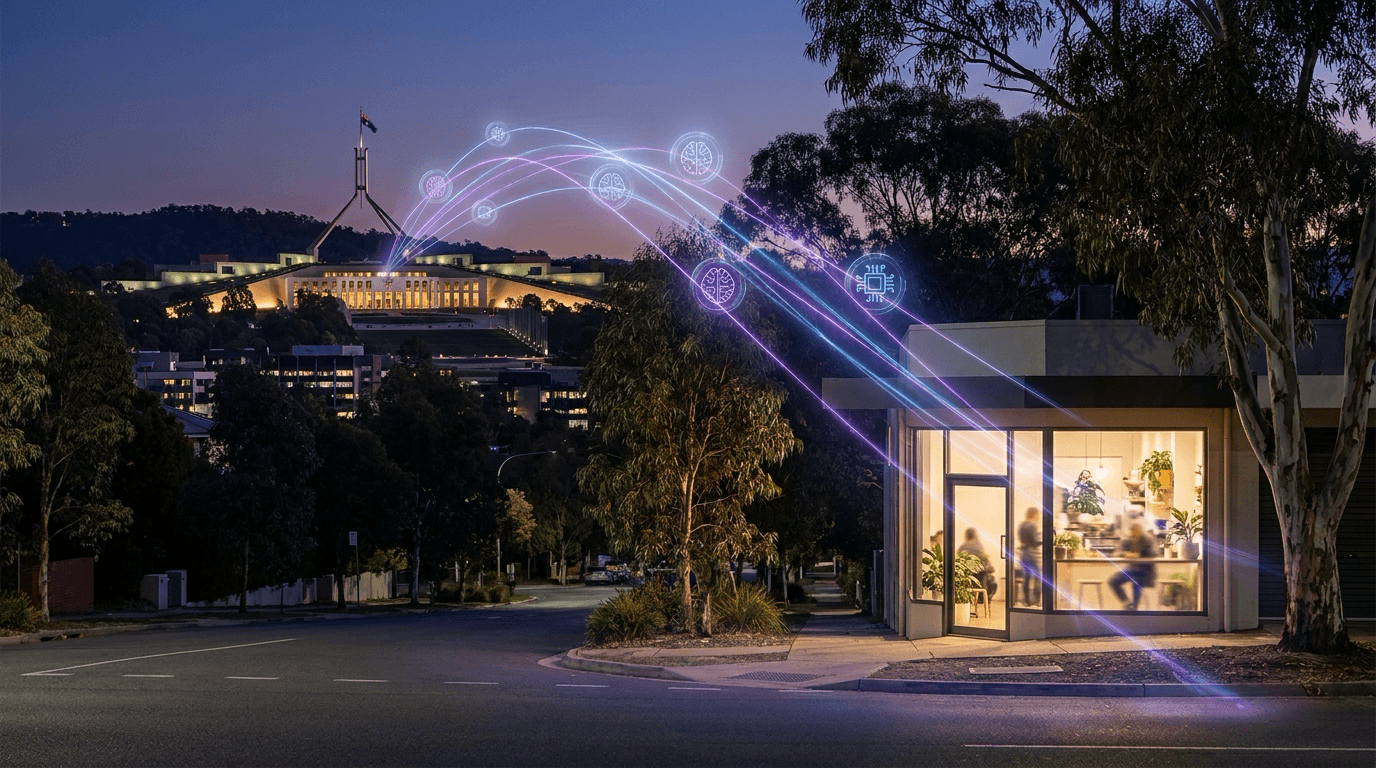
Here is the short version: nothing you must do today. The national AI framework announced by the Prime Minister on 15 July 2026 creates no new obligations for small businesses, and the legislation behind it is not expected until early 2027. But the decisions being made over the next six months will shape the AI tools you buy, the content you create and possibly your power bill. Worth a few minutes of your attention.
What was actually announced
- A new Office of AI inside the Department of the Prime Minister and Cabinet, operating immediately. Its job is to coordinate national AI standards across energy, copyright, employment, education and security.
- Those standards go to National Cabinet in August 2026 for consultation with the states, with legislation expected in early 2027.
- Mandatory rules for large data centres: they must supply their own power, pay their own grid connection costs, support the grid at peak times and meet water efficiency requirements.
- A commitment that no company may use Australian creative work to train AI "without the artist's control".
- Whole-of-government AI consumer safety priorities, promised as a follow-up.
What this means for you
The plain answer: the announcement contained no small-business measures at all. The effects on SMEs are indirect, and four are worth understanding.
1. The energy rules are about your power bill. AI data centres are enormous electricity consumers. Forcing them to bring their own generation and pay their own connection costs is designed to stop that demand flowing through to everyone else's bills. If it works, that is a quiet win for every business in the country.
2. The copyright commitment cuts both ways. If you are a photographer, designer, writer or agency, your work is getting stronger protection from being scraped into training data. But every business publishes content, and the same principle raises a question about the tools you use: what was your AI tool trained on, and could its output carry someone else's rights? Vendors will need clearer answers from 2027.
3. Standards will reach you through your software. When national standards become law, the companies building your accounting software, chatbots and marketing tools will have to comply. You inherit compliance mostly by choosing reputable tools, which is one more reason to keep a simple list of what AI your business actually uses.
4. Consumer safety rules are coming. The follow-up priorities are likely to touch chatbots and AI-generated content, where the practical question for a small business is disclosure.
The rules that exist right now
Until 2027, the main game in town is the Voluntary AI Safety Standard, ten guardrails published in 2024 covering things like human oversight, testing and transparency. It remains voluntary and creates no legal duties. But it is the clearest signal available of what the mandatory version will look like, and guardrail 6, which asks businesses to tell people when they are interacting with AI, is the one most likely to harden into law.
Three moves to make before the laws land
- List what you already use. Most businesses are surprised by their own answer once they count the AI built into email, accounting and design tools. Ten minutes, one page.
- Write a one-page AI use policy. What staff may use, what data never goes into public tools, who checks outputs. Our guide to AI risks for Australian SMEs is a good starting point.
- Adopt the two guardrails that matter most: a human reviews anything AI produces before it reaches a customer, and you are upfront when customers are dealing with AI.
Doing this now costs almost nothing and means the 2027 legislation arrives as a non-event for your business. If you would rather work through it with an advisor who knows your sector, our 45-minute consultations are funded by the Australian Government and free for eligible SMEs. Book a time here.
Frequently asked questions
Is AI regulated in Australia in 2026?
There is no AI-specific law yet. AI use is governed by existing law, including the Australian Consumer Law and the Privacy Act, plus a voluntary safety standard. Dedicated legislation is expected in early 2027.
What is the Office of AI?
A new office within the Department of the Prime Minister and Cabinet, announced on 15 July 2026, responsible for coordinating national AI standards. It is a policy body, not a regulator you deal with directly.
Do the new data centre rules affect my business?
Not directly. They apply to large data centre operators, and are designed to stop AI-driven electricity demand raising power prices for everyone else.
Will small businesses have to comply with the AI standards?
The detail is not settled, but obligations are expected to fall mainly on AI developers and large deployers. Small businesses will most likely be affected through the tools they buy rather than direct compliance duties.
Keep reading
More from the SMEC AI team.
 Industry Insights
Do I Have to Tell My Customers I'm Using AI?
No general Australian law forces businesses to disclose AI use, but four situations can put you on the wrong side of existing law. What SMEs must, should and needn't disclose.
 Tools & Reviews
Can AI Do My Bookkeeping and BAS? What Australian Accountants (and the ATO) Say
AI now handles reconciliation, receipts and invoicing well, but it cannot take responsibility for your BAS. What Xero's JAX can do, where it fails, and what the TPB requires.
 Industry Insights
AI-Powered Scams Are Outpacing Small Business Defences: How Australian SMEs Can Fight Back
Australians lost $2.18 billion to scams in 2025, and AI is making them harder to spot. Six practical defences every Australian small business can set up this week.