Other people's launches
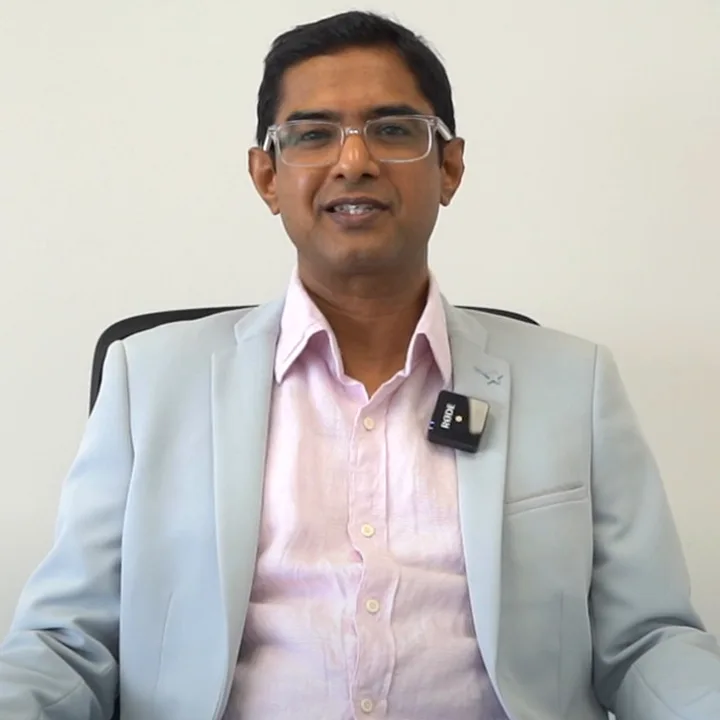
Before MakeMed, Ranjit Menon spent his career on the business side of change. He has been, in his words, "twenty years in the business of helping customers improve their lives". He helped organisations improve their business models and transformation programs, and he built the processes behind new products.
I've built workflows for companies to launch new products and services for customers at scale.
It started at home
The idea for MakeMed came from his own family.
“And then my daughter started to prepare for her UCAT.”
The UCAT is the admissions test for medicine and dentistry, used by universities in Australia, New Zealand and the UK. It has four timed subtests: Verbal Reasoning, Decision Making, Quantitative Reasoning and Situational Judgement. Watching the preparation up close, he saw where it got hard.
And I observed and I watched my daughter struggle in areas of time management, in motivation, as well as hitting an upper limit on her performance.
What a coach would do
MakeMed is a digital platform that helps students practise for the UCAT. He built it around one idea: "trying to be an effective coach for students who are aspiring to become future doctors or dentists". The platform does more than set questions: it watches how a student works.
And as an effective coach would do, my platform monitors how they actually go about their tests, what are the patterns that they have, what are their weaknesses and strengths, and where should they focus next to improve their performance.
Failures first
He always meant to build with AI. As he saw it, "competitors bolted on AI onto their platforms"; he "saw AI as an incredible tool to help me build the platform itself." The first attempts did not work, and he changed his method.
With AI he developed "the question bank and essentially analytical tools to be able to spot student issues, weaknesses, and where they could focus on." He also uses it to develop his business operations and controls.
The learning started with failures initially. I started with vibe coding, and based on the lessons that I learned, I switched the approach to a spec-driven development
Ten seconds to make sense
He came to AI Pathfinder, SMEC AI's eight-week program, with little background in startups. The program covered the basics he was missing.
“SMEC AI is a wonderful eight-week program, and it has really helped me, made me aware of various aspects of starting up an organisation, including finding funding and generally how a startup works, which I did not really have much awareness about.”
One exercise stuck. He showed his website, and his peers had ten seconds to guess what it was about. He credits Amir Nissen, SMEC AI's Head of Programs, for being "very direct and forthcoming in his feedback".
The feedback that I received in this particular session was incredible and really formed the basis of my landing page today.
After launch
His plans for MakeMed are about reach: new customers, and organisations that help students find it sooner.
After launch, the focus is gonna be entirely on scaling the business, acquiring new customers, and I'll also focus on partnering with organisations to make sure that students have quicker awareness and access to this tool.