Twenty years of strategy, then the AI boom
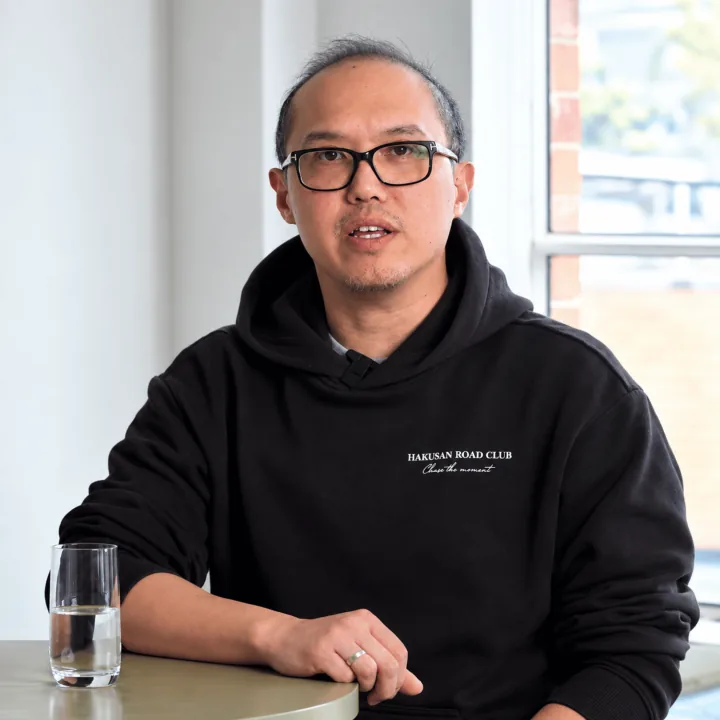
Suhit Anantula spent twenty years in strategy, innovation and design. That includes a director-level role in technology strategy at South Australia's Department of the Premier and Cabinet.
When generative AI took off, he read it as more than a technology shift.
The Helix Lab is his Adelaide consultancy, helping organisations "to reimagine what they do". He is the author of The Helix Moment and co-author of The Policy Playbook.
I saw all of this and said, "Okay, this is going to make a big difference to organisations, and it's bigger than technology." So that's why I set up the Helix Lab.
AI programs, but no view of the staff
Working inside organisations, he kept seeing the same pattern. The tools were being rolled out. What people did with them was much harder to see.
His instinct came from design work, where research means sitting down with people.
And so for a long time, I used to do design work, so we used to go and talk to people in real life. And when you talk to people in real life face-to-face, you learn a lot.
What a survey can't ask
Face-to-face interviews don't scale, and surveys miss the part that matters. A survey, he points out, can't ask "Are you worried to lose your job with AI?"
So he built a tool that holds the conversation instead. Ethnobot runs a research interview with each person, by chat or by voice, then turns the conversations into structured analysis. Its site sums it up as qualitative depth at survey speed.
So Ethnobot is basically a multi-agent system. You design your idea on what you want as a challenge, and the AI goes and talks to people. So you can just talk, as a chat, you can talk in voice, and in ten to twenty minutes, you get deep into how people think about their own challenges with AI.
From a consulting tool to a product
Ethnobot began inside the consultancy. In his words, the idea "started off trying to help my clients understand what challenges they're facing", and "then that became kind of a product now".
Teams can try it free with up to 15 people. Larger organisations can run a full study.
If you really want to understand how your organisation is changing, how your people are thinking, and really have a deep conversation with them, then this is your product.
Pulling the product out of the consultancy
When AI Pathfinder came along, he saw a chance "to put Ethnobot into this program and see if we can actually learn from it". The biggest change was structural: the product got its own track, apart from the consulting work.
So what the SMEC AI Pathfinder program did for me was it helped me kind of separate my consulting business to the product business and really help focus on that and say, "Where can Ethnobot go?" So now Ethnobot is becoming a product of its own.
Hard to work on yourself
Many of the ideas were not new to him. Applying them to his own business was the hard part. The program gave him a guide and a method to work through it "structurally, systematically", one question at a time.
For example, where is the market opportunity for Ethnobot? How do you price it? Can it go beyond AI adoption?
Beyond AI adoption
The answer to that last question turned out to be yes. Ethnobot is now aimed at "anybody who wants to understand what the employees are thinking about any challenge".
Since the program, Ethnobot has been selected for the National Digital Track of the Buy Australian AI Partnership, delivered by Stone & Chalk with the National AI Centre. He plans to take it "to the financial industry and really get it ready and hardened up to work in that space".
Further out, he wants leaders to be able to ask an AI agent "what are my people thinking today?" and get an answer drawn from Ethnobot's conversations.
But I think the biggest potential for Ethnobot, as I realise now after the few iterations, is actually it's not even about AI adoption. Every organisation wants to understand their staff, understand their employees, understand what they think, and they have a whole bunch of reasons to do it.