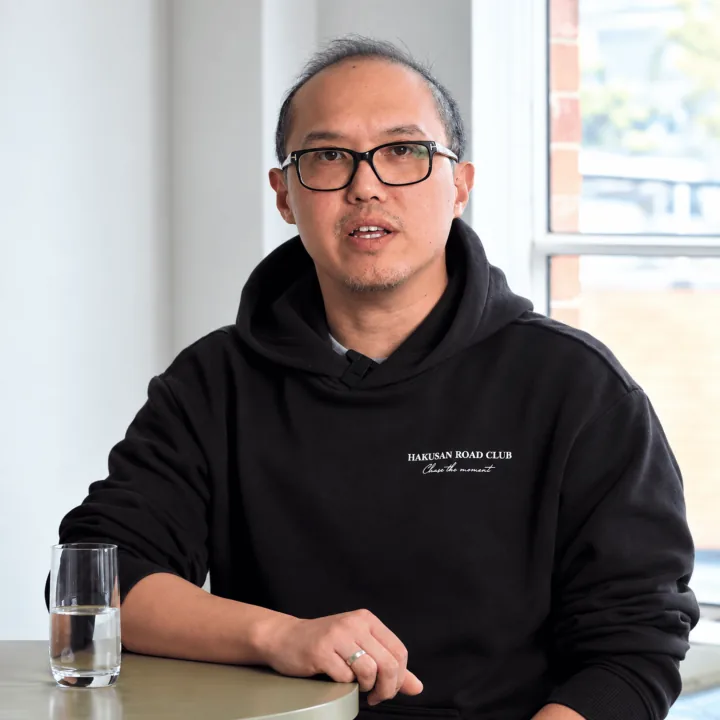
Five years watching good ideas wait
Before URauto.ai, Yavuz Uragun spent about five years in the solar industry automating business processes, working across commercial and technical teams. Academically he has gone wide rather than deep in one lane — degrees across psychology, business, programming and management, plus certifications and courses in data and data science.
That combination matters, because the problem he ended up building for is not a technical problem. It is an organisational one.
I worked in the solar industry for about five years, automating different business processes, but also working across some commercial teams and technical teams as well.
The queue between an idea and a working thing
Uragun is careful not to blame the process. He describes the traditional software development life cycle as excellent. The problem is what has happened around it: the supply of ideas went up, and the path to implementing one did not get any shorter.
“So I think the traditional software development life cycle is excellent. However, you know, everyone has an idea now, and there's a lot of red tape involved with implementing a lot of these ideas.”
Each approval is reasonable on its own. Together they decide which ideas ever get tested.
All of these different stakeholders play a role in how effectively we get to see our ideas through. So I think this is a really large challenge.
The gap nobody talks about
He backs the point with a figure he attributes to McKinsey: roughly 88% of businesses have now adopted AI into one of their workflows. The number that interests him is the second one — only about a third of those organisations manage to scale the technology across the organisation.
And I think that that gap between, you know, ideating and actually implementing is a large problem that needs to be looked at and solved and that's the challenge we're going after at urauto.ai.
Describe it, and it deploys
URauto.ai is a no-code, low-code B2B SaaS platform. A user writes a prompt in plain language; AI agents plan and write the code; the platform deploys it to the cloud as a Streamlit web application. The site's tagline is the whole product in three words: Automate • Integrate • Prototype.
The cloud it lands on is configurable rather than fixed — a GPU on the virtual machine, a larger hard drive, more compute or memory, a specific region. Work is version-controlled through GitHub, and an app is changed by re-prompting it.
Applications built for clients so far include an AI call centre, a plan-of-subdivision analyser and AI SMS agents.
It uses AI agents to write code, and then it'll deploy that code into the cloud in the form of Streamlit web applications.
He is his own first customer
The most direct evidence for the platform is how it was built. Uragun uses the agent to write the code for the platform, which in turn holds the agent that builds applications for customers — and then agents are integrated inside those applications to automate specific workflows.
The effect on delivery is the number he leads with: what would have taken a week now takes days. He is blunt about the dependency — two years of platform development, and he does not believe it would have been possible without gen AI running in the background.
So AI is just all across the business. I use it to develop the platform, to develop applications for clients and then we also integrate agents within the applications themselves…
A leash, not a cage
Ask what URauto.ai is really trying to solve and the answer is not speed. It is alignment — getting agents to do what the person actually intended. His framing is unusual, because it starts by defending the thing everyone else treats as the defect.
“The variability which they introduce is actually their super strength. However, you want that strength to be harnessed within specific boundaries and guidelines in which it operates in. Otherwise, it's gonna start to hallucinate or go off on tangents and do things that you didn't really intend for it to do.”
Putting a leash on these models to make them perform in more deterministic ways while still retaining the variability that gives them their strength.
Talking to the thing that builds
Today the way in is a text prompt. Uragun thinks that changes. The platform has implemented NVIDIA's PersonaPlex — an eight-billion-parameter model that is fully conversational, full duplex, meaning it can listen and speak at the same time. It also does backchanneling: the "mm-hmm" and "uh-huh" sounds that most conversational agents skip.
Being able to directly talk to your agent and see that agent develop the application for you in real time, I think is a very interesting use case of the platform, and that's where we're kind of headed.
What the first cohort settled
Uragun joined the first AI Pathfinder cohort. What he says it gave him is not a skill — it is a decision he had not yet made about himself.
The thing that made the difference was the room, not the curriculum — though he rates that too, singling out the structured content presented by Amir as of exceptional quality, and says it has stuck with him since. Asked for the single best part, he names the breakout rooms: talking to other founders one-on-one, bouncing ideas across, seeing what they were working on and how they were fixing it.
I mean, I joined the first cohort, and it's been extremely valuable in deciding whether, you know, I was gonna become an entrepreneur or a startup founder at the time.