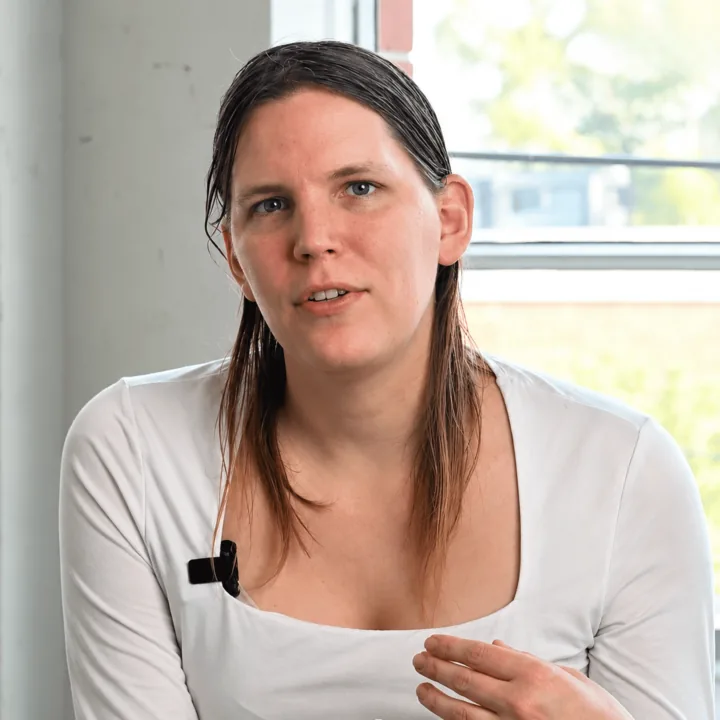
Twenty years inside other people's organisations
Doug Hawkins has spent his career designing how other people learn at work — across telecommunications, utilities, government, hospitality, retail, engineering, media, real estate and energy.
Yzly — pronounced wisely — is the first time that work has been his own. It sells ready-to-run courses that a manager can facilitate with their own team: around eight connected workshops, thirty to forty-five minutes each, with the facilitator's guide built in.
I'm a core learning designer at heart, and I've been doing it for over twenty years.
The only one in the business
A learning designer starting a company discovers that learning design is about a fifth of the job.
“So the challenge that I've really faced is trying to get this business off the ground. I'm the only one in the business, so trying to manage finance, marketing, website design, as well as the learning design and stakeholder engagement.”
He has no background in any of those first three. AI is what let one person hold all of them at once — not as a writing assistant, but as a set of standing capabilities he could call on.
What AI has done is it's allowed me to build a multifaceted business on my own.
He built something to argue with him
The part of his practice he cared most about protecting was his judgement. Twenty years of decisions about how adults learn — which he had never had to write down, because he had always been the one making them.
So he codified it, and then he built an adversary for it.
“So my challenger will take my designs, my rationale, my learning design and methods, and it will test my thinking, test my research, validate all of my research citations and bring that back to me.”
The effect was not that he wrote faster. It was that he could hold a standard across everything he made, and check it.
AI has allowed me to bring a level of consistency, rigour, research, discipline to learning design that what used to take me months now takes me days.
1,400 workshops, and then none
By March he had a library of 1,400 workshops and a product he was happy with. Then he ran it past the thing he had just built.
“To be honest, I got to the point in March of this year where I had 1,400 workshops. I had a vast library of workshops, and I was really happy with the product. And what I ended up doing was building a new quality control tool to challenge my thinking and my designs.”
He threw the lot out. A year of evenings, deleted, because a tool he wrote himself told him the standard had moved. He launched the rebuild the week before this interview, and is now shipping new programs weekly.
It's the best work of my life, and now I can offer that to any business.
Priced so it isn't a decision
Twenty years of the L&D industry taught him where the money goes: bespoke programs, for organisations with budgets to match. He priced against that deliberately.
He sells the course rather than the consultant: a manager already on the payroll runs it, so there is no external facilitator to hire.
“What this really does is the training packages that I'm putting together now bring quality learning to anybody at a budget. What I've done is I've actually priced it at scale.”
The trade is volume for access, and he is explicit that access is the point.
My focus isn't on designing bespoke programs for people with a big budget.
"My leaders aren't ready"
The objection came back from buyers almost immediately, and it is the one his whole product answers.
“A lot of companies were saying, 'My leaders aren't ready. They don't have the capability to facilitate learning.'”
He does not argue that the objection is wrong. He argues that it is temporary.
“That may well be true, but one fabulous thing about people is you give them the chance, and they'll build that capability.”
So the guides teach the subject and the facilitation at the same time — how to open a conversation, how to debrief one, what to do when a session goes sideways.
“This is a tool that teaches them how to teach, guides them through the conversations, gives them tips on how to debrief conversations.”
Managers who told him they could not do it have come back and said otherwise.
And the feedback that I'm getting is they're coming back to me and saying, 'This really works. I didn't think I'd be able to do it.'
A lonely journey, and a room full of people
He came into the AI Pathfinder program with a business he believed in and no one to test it against.
“The Pathfinder program was really critical and came to me at a point where I was in a real transition point. I had a very good business idea. I knew that it had merit in the market, but it was the network of people that I got to meet in Pathfinder.”
What he names first is not the curriculum. It is the open-house sessions — the standing appointment where a cohort of founders at the same stage could put a problem on the table.
“We could join the cohort and meet other people on a similar journey… and raise particular challenges and get that just-in-time advice at a point where we needed it.”
He has been working with AI for about three and a half years, which by his own reckoning makes him fairly new to it.
He now runs eight to ten models and agents in his everyday practice, and builds products with them in the background.
So having somebody that has the expertise that can help guide thinking, guide some strategic decisions to make sure that we're using the right tools in the right place for the right purpose.
What it is all for
“At the end of the day, these are just tools for connection.”