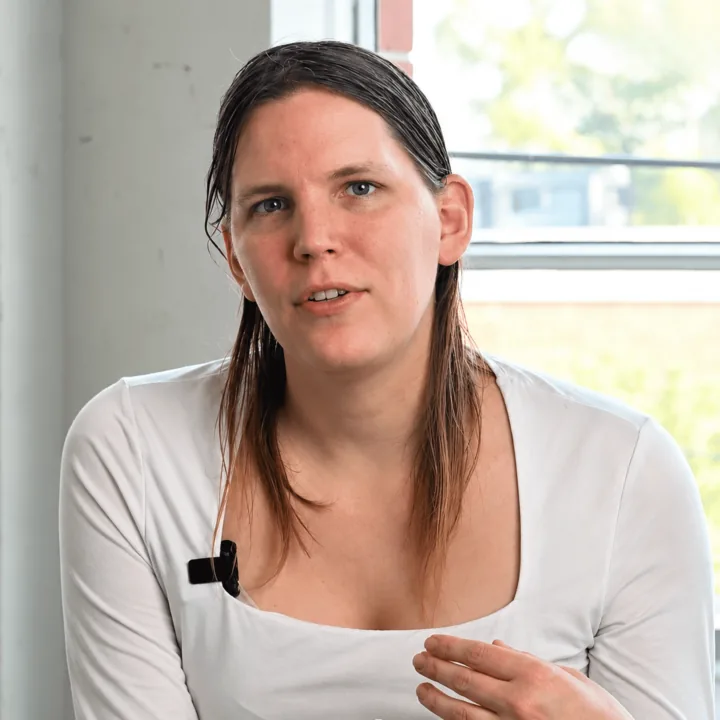
Twenty years in technology, then a loom
Priya Ravindra Kalyanimath spent two decades in technology, leadership and social entrepreneurship, managing multi-million-dollar projects across banking, higher education and government. She sits on boards, holds a GAICD, and was named one of Success Magazine's Top 25 Change Makers in the World for 2024.
None of which is the obvious background for a company whose product is handwoven cloth.
Punar brings together sustainable luxury artisan gifting and fashion, handwoven in India and sold to businesses in Australia, New Zealand, Singapore, the United Kingdom and the United States. Earlier this year its handwoven towels ended up at the Oscars Week Gifting Suite.
At Punar, what we do is we bring together sustainable luxury artisan gifting and fashion. They are all made in India by the artisans.
Punar means "again"
The name is Sanskrit, and it describes the material rather than the brand. Landfill textile becomes recycled yarn. Recycled yarn becomes handwoven cloth. Over a dozen women artisans have been taught the handloom that does it, using natural dyes and no chemicals.
To date that has meant 208 kg of clothing kept out of landfill and 750,000 litres of water saved — the water being the part most people miss, because it is spent before a garment is ever worn.
One of our biggest pride is that we've been teaching women to weave handloom products by using recycled yarn. So this means we are clearing landfill textile waste as well.
The customers are businesses, and they are being asked harder questions
Punar's buyers are small and medium businesses sourcing ethical gifting for events, and larger organisations investing in textile artisans through their corporate social responsibility programs. Every collection is made to order, so nothing is produced that nobody wanted.
What those buyers want, increasingly, is not a claim but a receipt.
We're also providing information on the makers, where the things are made, and transparency around the materials that are being used. So which is what all the companies love, because they wanna highlight the social impact by working with Punar.
The imperfect environmentalist
Most sustainable brands sell absolution. Punar does not, and its founder is unusually direct about why.
Her argument is arithmetic rather than moral. If you have ten things to buy, make one or two of them independent, ethical, and traceable to the person who made them. That is the ask.
We're not green shouting or yelling at you to buy sustainable product or making you feel guilty. We just want you to incorporate that little small shift in your habit and start buying one sustainable product at a time.
Time was the thing she was short of
The same refusal to be a purist shaped how she came to AI. She was not looking to transform the business. She was looking for hours.
I think time is a very precious commodity for everyone, and this is where I found out about SMEC AI. We've been hearing so many things about AI, but at the same time, there's so much noise out there. I knew AI was gonna make things easier. I just didn't know how.
Countless tools, and nobody impartial
The problem she names is not scepticism about AI. It is that everybody selling a tool has a reason to say theirs is the one.
“There's a lot of noise when it comes to AI these days, and there's also countless tools. But in order to be intentional, it is very important to get some guidelines from independent third parties, and that's where I think SMEC AI comes in the picture.”
What made the AI Pathfinder program usable, in her account, was its shape rather than its content: staged, step-by-step, broken into pieces small enough for someone already running a business. Plus a forum where she could watch other founders try things first.
We do not want one more thing, one more learning program, or yet another session.
Three to four days, now a few hours
Punar now uses AI to consolidate its production data in one place, to run social media, branding and marketing, and to operate agents that support day-to-day business operations.
The measurable change is in the marketing.
The foundations — the tone, the stories, the decisions about what Punar sounds like — are still set by a person. What went is the execution time.
Through using AI and creating AI agents, I would say our social media and marketing efforts has gone down by forty percent… We have set foundations, but the agents actually take maybe just a few hours to create the work which used to take us probably like three to four days worth of effort.
The big reset
Punar is becoming a platform: the collections, the materials and the makers in one place, including fabrics most buyers have never encountered — pineapple fibre, seaweed, banana leaf silk. The point of centralising it is verification.
“This is where AI will significantly help us to bring that transparency, credibility, all on a single platform, so people can see it for themselves and validate what's real and what's not.”
So I call this the big reset for the textile and the gifting industry.