The career break that started it
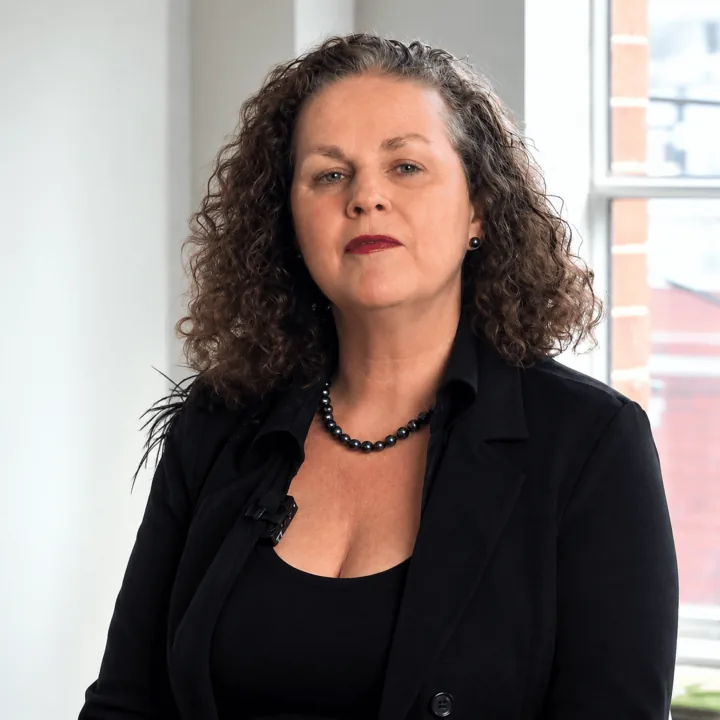
Pamela Frost took a career break after COVID, and came back to a question she had spent three decades helping other people answer, now pointed at herself.
"I took a career break post-COVID, and in coming back from that career break, I decided to explore my own career opportunities, and this was the end of 2023," she says. "So I started doing research into technology and the future of work."
What the research produced was not a plan. It was a fright.
"And the truth is, I became very overwhelmed about just how much change, how much is out there, worried about my own identity, my own professional capability."
I was concerned, what does this mean for me in terms of generative AI? Will it take my job?
Writing her way through it
Thirty-five years of practice in capability development did not spare her the question, and it did shape what she did with it. She wrote.
"So I started publishing, and I started writing. It was my way of coming to terms with it and understanding it. So I published the Chicken Little Chronicles."
The Chronicles found an audience, which was the point, and then the audience did something she had not planned for.
"After a period of time, whilst my audience really loved the concept and the characters that I created, they were asking questions like, 'What do I actually do? It's fine to talk about all of this stuff, but what do I actually do in terms of my career? Where should I concentrate? What are the most important capabilities to develop?'"
And so it was like a challenge. It was like, "What? You actually want me to come up with a solution?" And it was, "Yeah, I want you to come up with a solution.
So she started writing code instead
She had shipped software before. She had never written any of it.
"I've got previous experience developing software, but this is software that I had to outsource to overseas countries," she says. What she has built since is a different order of thing, and she is clear that it did not exist as an option until recently.
"What I've created now, there is no way on Earth I would've been able to do without the support of generative AI technologies. Just wouldn't be time-wise feasible, cost-wise feasible."
The build ran from ChatGPT to custom GPTs to the OpenAI Playground, into API integrations and prompts, and on to Claude Code. "So my apps are all AI-enabled," she says. "So yes, I'm using it incredibly rich way."
I don't have any coding background. Zero. I struggle to use the mobile phone at times, but I have been able to create code and do all of these amazing things, and it's self-taught, so it's really quite amazing.
The age of emergence
Adapt & Thrive is a set of eight tools with an AI agent, Crystal, at the centre of them — Insights, Shield, Compass, Navigator, Edge, Grow and Imagine, all running on frameworks Pamela spent a career building.
The framing she gives the whole thing is her own term.
"My business is all about navigating careers in what I call the age of emergence," she says. "Now, the age of emergence is emerging technology, which is creating so much change and so much uncertainty and ambiguity in industry."
Crystal is where a user meets it. "She's my AI agent that I have trained with all of my 35 years of career development, capability development, leadership frameworks, talent frameworks, expertise, and she will support you over your entire lifetime."
She's like a wise coach. She will never forget, and she will always have your back.
Who it is actually for
Pamela's customer is specific, and the specificity is the product.
"My ideal customer is a knowledge worker, a professional worker at round about 40 to 60, women who have worked really hard to get to where they are in their career," she says. "They've dealt with age discrimination. They've dealt with gender bias. They're at the top of their game. They're subject matter experts, and now they're needing to compete with the new kid on the block called digital autonomous agents, who never get tired."
That is the moment she built for — not the loss of a job, but the loss of a bearing.
"What does that person do when they are an SME becoming all of a sudden, 'I don't even know what I don't know anymore'?"
The answer the platform gives is a change of relationship rather than a change of career. "So instead of being worried about disruption, they become the disruptor."
You're not gonna be disrupted by tech. You're gonna be the conqueror. You're going to be the sovereign over technology and make it work on your terms.
What the program was for
By the time Pamela reached AI Pathfinder she could already build. What she describes getting is the part that is not building.
"Look, it's been a fabulous program in terms of learning. It is a very steep learning curve," she says. The content runs from the questions a business has to answer before it has anything — "what is your market? What is your ideal customer? What are the pain points?" — through to growth, measurement, traction and fundraising.
"So there's a lot of knowledge that you gain from this course, but there's also wonderful people that you meet in that process."
The people are what she names first when asked for the best part.
"I think the community for me has been the best opportunity. Having the chance to meet other founders and not just online in the courses but in real life."
There are other people out there just the same stage as you doing the same thing, and it's nice to learn in a community.
Where it goes next
The business runs consumer-first today, and Pamela is explicit that the sequence is deliberate: build the trust with individuals, then take it into the organisations they work for.
The goal, she says, is to be "high, high tech but high support, to be a application of preference for professionals, white-collar workers, subject matter experts who are doing something similar to me."
My next point is to then provide support to organisations directly in upskilling your workforce and changing their relationship with technology from perhaps one of ambivalence or uncertainty or fear to one of excitement, of wonder and curiosity.