Five Australian AI policy priorities: what they mean for small businesses
Australia announced five AI policy priorities in July 2026. We explain which businesses they concern, what is proposed and which obligations already apply.
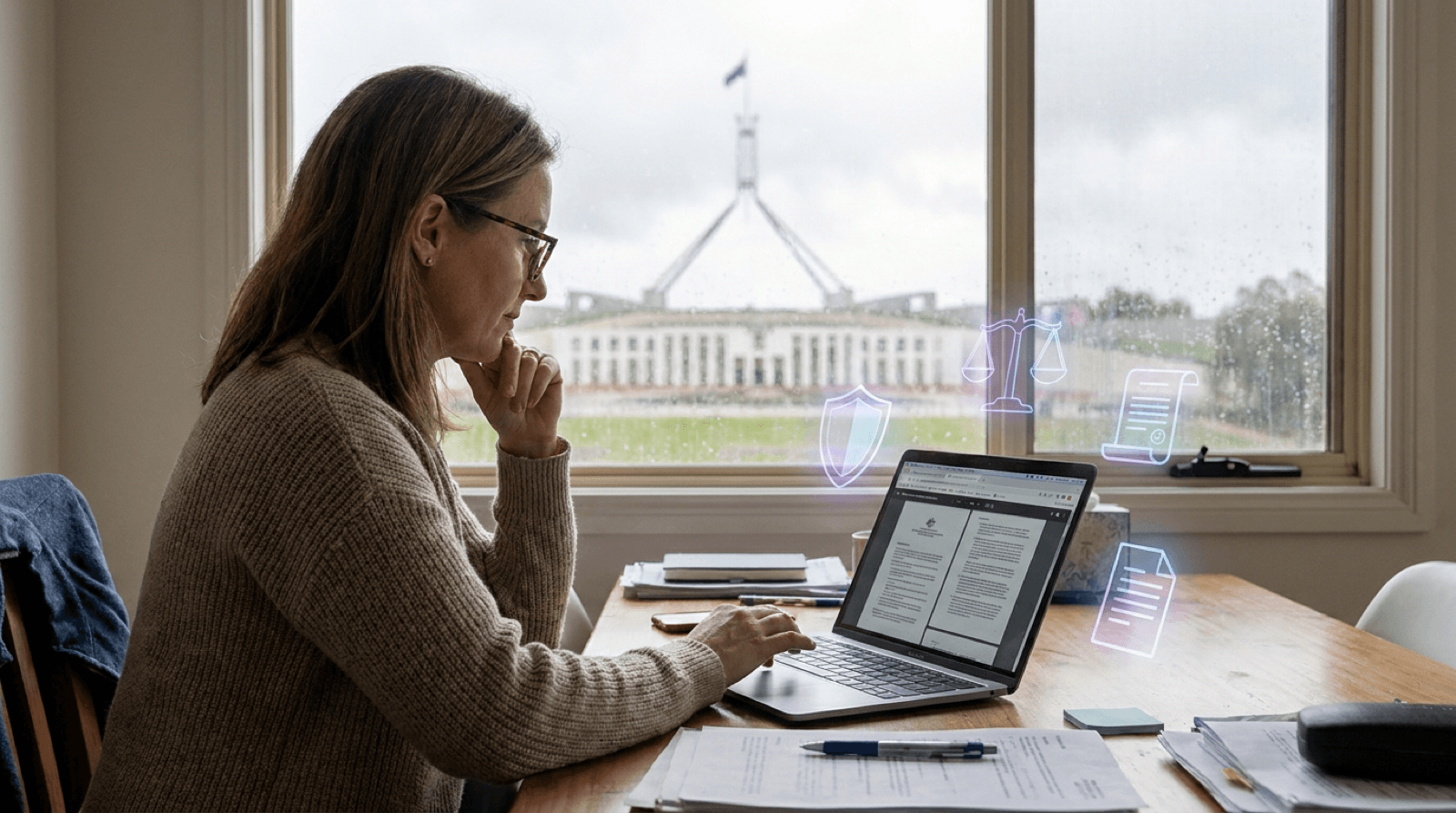
If you use AI to draft quotes, the usual rules about misleading customers already apply. Running an online service that other people use is a different question. Here we explain who each of the five federal priorities is aimed at and what you can check now.
On 20 July 2026, several federal ministers jointly announced five AI consumer-safety priorities (Treasury media release). The list is not exhaustive. For the wider backdrop, see our post on the National AI Plan and the Office of AI.
| Priority | Where it stands | Who should pay attention? |
|---|---|---|
| Digital duty of care | Bill passed the House on 28 October 2026; now before the Senate | Potentially, if you provide a covered online service |
| Privacy reform | Consultation on the exposure draft ran from 31 August to 18 September 2026 | If the Privacy Act covers you |
| AI in the workplace | Being discussed by a government, union and business forum | Relevant if you use digital systems to allocate or monitor work |
| Consumer protection | Government is examining options | The Consumer Law already applies |
| Automated decisions | Proposed framework for federal agencies; separate Privacy Act changes apply from 10 December 2026 | Not under the federal agency framework. Check the separate privacy rule below. |
1. Digital duty of care
On 15 October 2026, the government introduced the Online Safety Amendment (Digital Duty of Care) Bill 2026. It proposes a duty for providers of covered online services to take reasonable steps to keep Australian users safe. The House of Representatives passed an amended version on 28 October. It is now before the Senate, where a committee is due to report on 20 November (bill record). As drafted, the duty would start 12 months after the bill becomes law.
Using a chatbot to write a quote is different from providing an online service for other people to use. The proposed duty is aimed at providers of covered services. If you run your own app, website or messaging feature where users post or generate content, ask your lawyer.
2. Privacy reform
The Attorney-General’s Department sought feedback on a second round of Privacy Act changes. The exposure draft, the Privacy Amendment (Personal Data Protection) Bill 2026, was open for comment from 31 August to 18 September, and the Attorney-General's Department says it "remains subject to further consideration by government" (consultation page). Law firms Maddocks and Bright Law both noted that the draft does not remove the small business exemption.
That exemption covers businesses with annual turnover of $3 million or less, with exceptions including health service providers and businesses that trade in personal information. If sharing personal information is part of your business model, check how the current exceptions apply to you. If you are under the threshold, check the exceptions before assuming you are out.
3. AI safety in the workplace
Minister Amanda Rishworth is taking this to the Artificial Intelligence Workplace and Employment Forum, where it is one of five agreed priorities. The forum is a non-statutory advisory body, so it can recommend but not legislate. HRD Australia reported in April that members include the ACTU, Business Council of Australia, Ai Group and ACCI, and that it will test whether current laws are fit for purpose.
Existing workplace and safety duties still apply when you use AI. New South Wales passed the Work Health and Safety Amendment (Digital Work Systems) Act 2026 in February. If you employ people in NSW and use digital systems to direct their work, check what it covers and when it starts.
4. Consumer protections
Assistant Minister Andrew Leigh is examining whether the Australian Consumer Law needs changes for risks like retail surveillance pricing and agentic commerce, meaning software that shops on someone's behalf. There is no timeline. A Treasury review that reported in October 2025 found the Consumer Law "remains broadly fit-for-purpose" for AI, according to Gilbert + Tobin.
For you, that means the existing rules are the ones to worry about. The government's own guidance says the Consumer Law's misleading and deceptive conduct provisions, along with the Privacy Act and Copyright Act, apply to AI-generated content (guidance). In our reading, that covers a website chatbot that quotes the wrong price as much as an ad that overstates your product.
The fifth priority concerns automated decisions by federal agencies. A separate Privacy Act change matters for some businesses: from 10 December 2026, organisations covered by the Australian Privacy Principles must describe certain uses of personal information in their privacy policies when automated decisions could significantly affect a person’s rights or interests.
What to do now
- Find out if the Privacy Act covers you. Check your turnover and the exceptions. Our post on AI risks for Australian SMEs explains the basics.
- List your AI tools. Write down which ones you use and what customer or staff information goes into them. That record helps you answer a customer who asks how their information was used.
- Be straight with customers. No new law is needed for that. See do I have to tell customers I'm using AI.
If you want help working out where you sit, our AI Risk & Governance page explains how eligible businesses can book a free 20-minute discovery call.
Frequently asked questions
Is there an AI law in Australia?
Not one law covering every business. The July priorities are work in progress. Existing laws, including the Australian Consumer Law and, for covered businesses, the Privacy Act, already apply to how you use AI.
Does the Privacy Act apply to my small business?
Generally only if your annual turnover is over $3 million or you fall into an exception, such as being a health service provider. The August draft Bill did not remove the exemption, according to two law firms.
When will the digital duty of care start?
Not yet. The bill has passed the House but still needs to pass the Senate. If you provide an online service that may be covered, check the final legislation and its commencement provisions before relying on a start date.
Do I need to do anything about these rules now?
Check your current obligations first. Note which AI tools you use, what customer or staff information they handle and who reviews their decisions.
Sources and further reading
Keep reading
More from the SMEC AI team.
 Government Programs
Australia's National AI Plan: What the New Office of AI Actually Means for Your Small Business
The Office of AI creates no SME obligations yet. Legislation is expected in early 2027. What changes for a small business now, and what can wait.
 Industry Insights
Why Isn't AI Paying Off in My Business?
Most businesses using AI see little gain on the bottom line yet. Three things to fix first: the handovers, who checks the work, and your corrections.
 Industry Insights
Where Can NDIS Providers Use AI to Cut Admin?
Where NDIS providers can use AI for routine admin, how to protect participant information and what a worker needs to check before signing off a record.